Table of Contents
3D printing becomes much easier when you understand the relationship between your printer, filament, and software. For users of Bambu Lab printers, choosing the right bambu 3d printer filament can make a noticeable difference in print quality, strength, flexibility, and how easy a project is to complete.https://londoncityinsight.co.uk/moxhit4-6-1-software-testing/
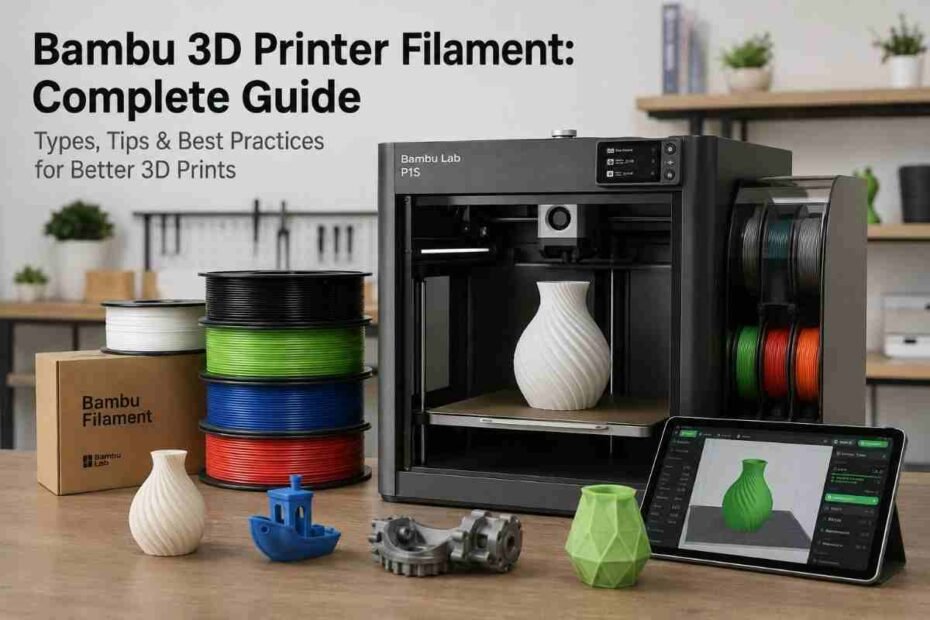
This guide explains the main filament choices, how they work with Bambu Lab printers, and what to consider before starting a print. It also looks at the Bambu 3D printer P1S, Bambu Studio software, and where users can find bambu 3d printer files for different projects.https://bambulab.com/en
What Is Bambu 3D Printer Filament?
Bambu 3D printer filament is the material fed into a compatible 3D printer to create a physical object layer by layer. Filament comes in different materials, and each material has different characteristics.
Some common options include:
- PLA: Easy to print and widely used for models, decorations, prototypes, and general projects.
- PETG: A useful choice when a project needs different properties from standard PLA.
- TPU: A flexible material suitable for projects where some flexibility is needed.
- ABS and ASA: Materials used for applications where greater heat or environmental resistance may be useful.
- PA and PC: More specialized materials that can require greater attention to printing conditions.
The best choice depends on the object you are making rather than simply choosing the most expensive filament.
How to Choose the Right Bambu 3D Printer Filament
Before buying filament, think about what the finished object needs to do.
For Simple Models and Everyday Projects
PLA is often a practical starting point for people who are learning 3D printing. It is commonly used for decorative objects, models, organizers, and many household projects.
If your project does not need unusual strength, flexibility, or heat resistance, there may be little reason to start with a more demanding material.
For Stronger or More Functional Projects
PETG can be useful for functional objects that need characteristics different from ordinary PLA. It is often considered for brackets, containers, mechanical parts, and other practical prints.
However, material selection should always follow the requirements of the individual project.
For Flexible Objects
TPU is designed for applications where flexibility is important. This can make it useful for certain protective parts, flexible components, and other objects that should not behave like a rigid plastic.
Flexible filament can require different settings from rigid materials, so users should follow the recommended profile for their specific printer and filament.
Understanding the Bambu 3D Printer P1S
The Bambu 3D printer P1S is an enclosed printer designed for a range of materials. According to Bambu Lab’s specifications, the P1S has a 256 × 256 × 256 mm build volume, a 300°C maximum hot-end temperature, and a 100°C maximum build-plate temperature. Bambu Lab lists PLA, PETG, TPU, PVA, PET, ABS, and ASA among its supported materials, with PA and PC also listed as capable materials.
The enclosed design can be useful when working with materials that benefit from a more controlled printing environment.
The P1S also supports an Automatic Material System, or AMS, for multi-material printing. Bambu Lab says the system can support multi-color printing when compatible AMS hardware is used.
That does not mean every filament is automatically suitable for every setup. The nozzle, material properties, printer profile, and recommended printing conditions still matter.
What Makes the P1S Useful for Different Filaments?
One advantage of an enclosed printer is that it gives users more flexibility when experimenting with materials.
The P1S includes an all-metal hot end and a stainless-steel 0.4 mm nozzle as standard, while other nozzle diameters are available separately. Bambu Lab’s specifications also distinguish between materials it considers ideal for the P1S and materials it considers capable with the printer.
This distinction is important.
A printer being technically capable of handling a material does not mean that the material is equally easy to print. More demanding filaments may require appropriate settings, suitable hardware, and careful preparation.
Bambu 3D Printer Software: Using Bambu Studio
Hardware is only one part of the 3D-printing process. You also need software that converts a 3D model into instructions the printer can understand.
Bambu 3D printer software, particularly Bambu Studio, is used to prepare models for printing. It allows users to select a printer, choose filament settings, adjust print parameters, and slice a model before sending it to the printer.
The software also provides filament profiles. Bambu Studio includes system filament presets as well as options for creating custom filament profileshttps://londoncityinsight.co.uk/brumeblog-com/
This can be especially useful when you are not using a standard Bambu Lab filament.
Why Filament Profiles Matter
A filament profile contains settings that help the slicer determine how the printer should handle a particular material.
Using an unsuitable profile can contribute to printing problems such as poor surface quality, weak layers, or other unexpected results.
When using third-party filament, check the manufacturer’s recommended settings and compare them with the available settings in Bambu Studio. If necessary, a suitable custom profile can be created rather than simply assuming that every PLA or PETG spool should use exactly the same settings.
Finding Bambu 3D Printer Files
Before you can print something, you need a suitable 3D model. Bambu 3D printer files can come from several sources, including models designed specifically for particular printers or printing setups.
Bambu Lab’s MakerWorld platform provides downloadable 3D models and collections. For example, MakerWorld includes collections containing models related to Bambu Lab printers.https://3dprint.pk/products/bambu-lab-pla-basic-3d-printing-filament
When choosing a file, do not look only at the picture. Check the information supplied with the model.
Look for details such as:
- Recommended filament
- Printer compatibility
- Nozzle requirements
- Layer height
- Whether supports are required
- Number of colors or materials
- Special assembly instructions
- Any recommended print settings
A model that looks simple can still require particular settings to produce the expected result.
Should You Use Bambu Filament or Third-Party Filament?
There is no universal answer.
Bambu Lab filament can be convenient because it is designed to work within the company’s printer and software ecosystem. However, compatible third-party filament can also be useful when its specifications and recommended settings are appropriate for your printerhttps://londoncityinsight.co.uk/beta-character-ai-login/
The important thing is to understand the material rather than choosing based only on the brand.
When considering another filament, check:
- The material type.
- Recommended nozzle temperature.
- Recommended bed temperature.
- Whether the material needs drying.
- Whether your printer and nozzle are suitable.
- Whether an appropriate profile is available.
- Whether the filament is compatible with your particular AMS setup, if you use one.
This approach is more reliable than assuming that every spool labeled PLA, PETG, or TPU will behave exactly the same way.
How the AMS Changes Filament Management
The Automatic Material System can make multi-color and multi-material printing more convenient. Bambu Lab describes the P1S as capable of up to 16-color printing when multiple compatible AMS units are used.
However, the AMS does not remove the need to manage filament correctly.
Users should make sure the selected filament in the software corresponds to the material actually loaded in the appropriate slot. This is particularly important when using third-party filament.
If the software believes one material is loaded while a different material is physically installed, the selected printing profile may not match the material being used.
Tips for Better Filament Results
Even a good printer can produce disappointing results when filament is poorly stored or the wrong settings are selected.
Keep Filament Properly Stored
Many filament materials can be affected by moisture. Keeping filament in an appropriate dry storage environment can help maintain its condition.
If a filament manufacturer recommends drying a particular material, follow those instructions rather than applying the same treatment to every type of filament.
Match the Material to the Project
Do not choose filament simply because it sounds more advanced.
For example, a decorative model may not need a specialized engineering material. Likewise, a functional component exposed to particular conditions may require more consideration than a simple display model.
Check the Recommended Profile
Start with a suitable manufacturer or software profile when one is available. From there, adjustments can be made if the project requires them.
Pay Attention to the Nozzle
Different materials can have different requirements. Some specialized or fiber-filled filaments can be more demanding on printer hardware, so check compatibility before printing.
The P1S supports several nozzle diameters, and Bambu Lab distinguishes material compatibility depending on the nozzle and material combination.
What Is the Best Bambu 3D Printer?
The phrase best bambu 3d printer does not have one universal answer because the right printer depends on the user’s projects, materials, budget, and desired features.
For someone interested in an enclosed Bambu Lab printer, the P1S is one option worth considering. It combines an enclosed design with a 256 × 256 × 256 mm build volume and support for a range of common and more advanced materials.
However, printer selection should come after deciding what you actually want to print.
Consider:
- What materials you plan to use
- Whether you need an enclosed printer
- The size of your typical models
- Whether multi-color printing matters to you
- How much control you want over print settings
- Which software and workflow you prefer
A printer that fits your actual projects is generally a better choice than simply selecting a model because it is popular.
Bambu Filament and Print Quality
Filament is only one part of print quality.
The final result can also depend on the model itself, printer calibration, nozzle condition, build plate, temperature settings, layer height, print speed, cooling, and environmental conditions.
This is why changing filament alone does not always solve a printing problem.
If a print fails, check the entire workflow. Confirm that the correct printer and filament profiles are selected, make sure the model is properly sliced, and check whether the material requires specific preparation.
Frequently Asked Questions
Can I use third-party filament with a Bambu 3D printer?
In many cases, yes, provided the filament is compatible with the printer and the appropriate printing settings are used. Bambu Studio also supports custom filament profiles.
Is PLA a good filament for beginners?
PLA is commonly used for general-purpose 3D printing and can be a practical material for beginners. However, the best choice still depends on the specific project.
What filament works with the Bambu 3D printer P1S?
Bambu Lab lists PLA, PETG, TPU, PVA, PET, ABS, and ASA as ideal materials for the P1S, while PA and PC are listed as capable materials. The exact setup and nozzle can affect compatibility.
Where can I find Bambu 3D printer files?
Bambu Lab’s MakerWorld platform provides downloadable 3D models and collections. Always check the model’s recommended printer, filament, and settings before starting a print.
Do I need Bambu filament to use Bambu Studio?
No. Bambu Studio supports system filament presets and custom filament profiles, allowing users to configure compatible third-party materials as needed.
Conclusion
Choosing the right bambu 3d printer filament is about matching the material to the printer and the project. PLA can be a practical choice for many everyday models, while PETG, TPU, ABS, ASA, and other materials can serve different purposes.
The Bambu 3D printer P1S provides an enclosed printing platform with support for a broad selection of materials, while Bambu Studio helps users prepare models and manage filament settings.
Rather than searching for one universally perfect filament or the best bambu 3d printer, focus on your own printing needs. Choose the material carefully, use appropriate software settings, check model requirements, and keep your filament in good condition. That simple approach can make the entire 3D-printing process more predictable and enjoyable.
Pingback: Business RobTheCoins: A Guide to Crypto & Blockchain