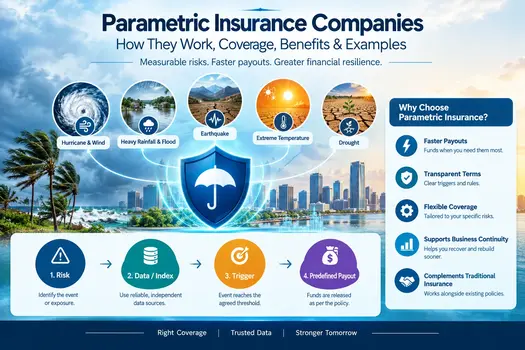
When a major storm, earthquake, drought, flood, or other measurable event disrupts a business, waiting for a conventional insurance claim to be assessed can create another financial problem. Parametric insurance takes a different approach: instead of calculating the exact physical loss first, it uses a predefined measurement or index to determine whether a payout is triggered. That can make recovery funding faster and more predictable.
This guide explains parametric insurance in simple terms, including how it works, common triggers, real-world applications, benefits, limitations, basis risk, pricing considerations, and how it compares with traditional insurance.
What Is Parametric Insurance?
Parametric insurance is a type of insurance that pays a predetermined amount when an agreed measurable event reaches a specified threshold.
Instead of waiting for an adjuster to calculate the exact amount of physical damage, the policy uses an objective parameter such as:
- Wind speed
- Rainfall
- Temperature
- Earthquake magnitude
- Ground acceleration
- Flood depth
- Cyclone intensity
- Drought conditions
- Wildfire proximity
For example, a policy could specify that a payout becomes available when wind speed at a defined location exceeds a particular threshold.
The policy wording determines the trigger, measurement source, payout formula, covered location, and other conditions.
The National Association of Insurance Commissioners describes parametric disaster insurance as coverage based on the magnitude of a specified event rather than the measured amount of loss. Swiss Re similarly describes it as index-based protection linked to a predefined intensity threshold.
How Does Parametric Insurance Work?
The basic process is straightforward.
1. Define the Risk
The policyholder identifies a specific risk that could create a financial impact.
Examples include:
- Excessive rainfall
- Severe wind
- Earthquake activity
- Drought
- Flooding
- Extreme temperatures
2. Select the Parameter
The insurer and policyholder select an objective measurement that can represent the event.
For example:
Risk: Hurricane
Parameter: Maximum sustained wind speed
Trigger: Wind speed reaches the agreed threshold
3. Establish the Trigger
The policy defines exactly when the coverage responds.
The trigger must be measurable and independently verifiable. A reliable data provider or verification mechanism is therefore an important part of the policy design.
4. Set the Payout
The policy specifies how much money becomes payable when the trigger is reached.
A simple structure might look like this:
| Event Measurement | Payout |
| Below trigger | $0 |
| Trigger reached | 25% |
| Higher threshold reached | 50% |
| Severe threshold reached | 100% |
Actual structures vary by policy.
5. Verify the Event
After the event occurs, the agreed data source determines whether the trigger was reached.
Depending on the policy, information may come from government agencies, weather stations, satellites, seismic networks, sensors, or other approved data providers.
6. Release the Payout
If the contractual conditions are satisfied, the payout follows the policy’s predefined mechanism.
This structure can reduce the need for a conventional physical damage assessment.
What Are the Main Components of Parametric Insurance?
A well-designed policy normally brings several components together.
| Component | What It Means |
| Insured risk | The event or exposure being protected |
| Parameter | The measurable variable used by the policy |
| Trigger | The threshold that activates payment |
| Data source | The organization or system measuring the parameter |
| Payout formula | The method used to calculate payment |
| Coverage limit | The maximum amount available |
| Covered location | The geographic area included |
| Policy period | The dates during which protection applies |
| Verification process | The method used to confirm the trigger |
These details matter because the quality of the trigger determines how closely the policy responds to the risk the buyer actually faces.
What Are Examples of Parametric Insurance?
Parametric insurance can be designed around many measurable risks.
Weather Insurance
A policy may respond when rainfall, temperature, or wind reaches a specified level.
This can be useful for businesses whose revenue or operating costs are strongly affected by weather.
Earthquake Insurance
An earthquake policy could use measurements such as magnitude or ground acceleration at a specified location.
The policy might establish several trigger levels, with larger payouts associated with more severe measurements.
Flood Insurance
Flood-related parametric coverage can use measurements such as water depth or another predefined flood indicator.
The exact trigger depends on the available data and policy structure.
Agricultural Insurance
Farmers can face drought, excessive rainfall, heat, and other weather-related risks.
Index-based agricultural insurance has been used to provide payments based on measurable conditions rather than traditional individual loss assessments. The World Bank has documented applications involving rainfall and other climate indicators.
Wildfire Risk
A policy could use satellite or other independently verified information to determine whether a defined wildfire condition has occurred within a specified area.
Business Interruption
Parametric structures can also be designed to provide liquidity following certain external events that disrupt operations.
The important distinction is that the payment depends on the agreed trigger rather than simply calculating every dollar of actual damage.
Why Is Parametric Insurance Important?
Traditional insurance remains an important way to transfer risk, but certain situations create challenges for conventional claims processes.
A disaster can make physical inspections difficult. At the same time, a business may need cash immediately for payroll, temporary facilities, emergency logistics, repairs, or other operating expenses.
Parametric insurance can address part of this liquidity problem by establishing the trigger and payout structure before an event occurs.
The World Bank has highlighted the potential for index-based insurance to provide faster financial support after climate and disaster events.
What Are the Benefits of Parametric Insurance?
Faster Access to Funds
Because the payout is tied to an agreed measurement, the process may not require a full physical loss adjustment.
Greater Payout Transparency
The policy can clearly state what measurement activates the coverage and how the payout is calculated.
Flexible Policy Design
Coverage can be structured around a particular risk, location, business exposure, and financial requirement.
Protection for Difficult Risks
Some risks are difficult to insure through conventional property structures. Parametric solutions can sometimes complement existing coverage where protection gaps exist.
Useful for Liquidity Planning
A predefined payout can help organizations plan for immediate cash requirements following a qualifying event.
Complementary Coverage
Parametric products do not necessarily have to replace traditional insurance. They can operate alongside conventional policies.
Swiss Re notes that parametric solutions can be considered for hard-to-insure physical risks and financial exposures, particularly where transparent and fast payment is valuable.
What Is Basis Risk in Parametric Insurance?
Basis risk is one of the most important concepts to understand before buying parametric insurance.
It occurs when the parameter used by the policy does not perfectly match the actual financial loss experienced by the policyholder.
Imagine a business has a policy triggered by rainfall below a certain level.
The rainfall measurement might not reach the trigger, but the business could still suffer a financial loss.
The opposite can also happen: the trigger may be reached and the policy may pay even though the policyholder’s actual loss is smaller than the payout.
This difference exists because parametric coverage responds to the agreed index rather than calculating every individual loss.
The World Bank identifies basis risk as a central challenge in index-based insurance because the measured index may not perfectly correlate with the actual risk experienced by the insured.
How Can Basis Risk Be Reduced?
Good policy design can help reduce the gap between the trigger and the underlying exposure.
Important considerations include:
- Choosing a parameter closely connected to the insured risk
- Selecting an appropriate geographic area
- Using reliable data sources
- Testing historical scenarios
- Reviewing the trigger against past events
- Using multiple thresholds where appropriate
- Matching the payout structure to the organization’s financial exposure
- Reviewing the policy regularly as risk conditions change
A cheap trigger is not automatically a good trigger. The goal is to create a measurement that makes practical sense for the risk being transferred.
Parametric Insurance vs. Traditional Insurance
The biggest difference is how the payout is determined.
| Feature | Parametric Insurance | Traditional Insurance |
| Primary trigger | Measurable event or index | Covered loss |
| Damage assessment | Often limited or unnecessary for trigger determination | Usually required |
| Payout basis | Predefined formula | Adjusted covered loss |
| Speed | Can be faster after verification | Depends on claims process |
| Basis risk | Important consideration | Generally structured around actual covered loss |
| Flexibility | Can be tailored to specific measurable risks | Usually tied to defined insured property/loss |
| Best use | Event-driven liquidity and protection gaps | Physical loss and indemnity protection |
Neither structure automatically fits every situation.
The right choice depends on the exposure, policy terms, available data, financial objectives, and regulatory environment.
Who Uses Parametric Insurance?
Potential users include:
Businesses
Companies exposed to severe weather, natural catastrophes, supply disruptions, or other measurable events can consider parametric coverage as part of their risk strategy.
Agriculture
Farmers and agricultural businesses can use weather or climate indexes to address risks such as drought and excessive rainfall.
Energy Companies
Renewable energy and other weather-sensitive businesses may have financial exposure to unusual weather conditions.
Hospitality
Hotels and resorts can face substantial revenue pressure following storms, floods, or other disruptive events.
Governments and Public Entities
Public-sector organizations can use catastrophe risk-transfer structures to obtain funds following predefined disaster triggers.
The World Bank has documented parametric approaches used in sovereign disaster-risk financing and agricultural resilience programs.
What Role Does Technology Play?
Modern parametric products depend heavily on reliable data.
Potential data sources include:
- Weather stations
- Satellite imagery
- Seismic networks
- Remote sensing
- Environmental sensors
- Radar
- Geographic information systems
- Government datasets
Technology can also support historical analysis and scenario testing.
For example, insurers can examine historical weather measurements to determine whether a proposed trigger would have responded in a way that reasonably reflects the client’s exposure.
The data source therefore becomes more than a technical detail. It is a core part of the insurance contract.
How Is Parametric Insurance Priced?
Pricing depends on the risk and policy structure.
Factors may include:
- Probability of the trigger occurring
- Severity of the insured event
- Geographic exposure
- Historical event data
- Coverage limit
- Payout curve
- Policy duration
- Data quality
- Deductibles or other policy features
- Administrative and capital costs
- Reinsurance conditions
A higher trigger threshold may reduce the frequency of payouts, while a lower threshold can increase the likelihood of payment.
Pricing should therefore be considered alongside the quality of the protection, not in isolation.
What Should Buyers Check Before Purchasing?
Before entering a parametric policy, buyers should understand the trigger in practical terms.
Use this checklist:
- What exactly activates the policy?
- Who measures the trigger?
- Which data source has contractual authority?
- What happens if the data source becomes unavailable?
- Where must the event occur?
- How is the payout calculated?
- What is the maximum payout?
- Could actual losses occur without triggering payment?
- Could the policy pay when actual losses are relatively small?
- How does the policy interact with existing insurance?
- What regulatory rules apply in the relevant jurisdiction?
- How often should the trigger and payout structure be reviewed?
These questions can expose basis-risk issues before a policy is purchased.
Can Parametric Insurance Replace Traditional Insurance?
Not necessarily.
In many situations, the two approaches can complement each other.
A company might use traditional property insurance for physical damage while adding a parametric layer to provide faster liquidity after a severe weather event.
For example:
Traditional coverage: Physical property damage
Parametric layer: Immediate funds following a defined catastrophe trigger
This combined approach can address different parts of the same risk.
The exact structure depends on the policy wording, jurisdiction, underwriting requirements, and the insured’s exposure.
What Is the Future of Parametric Insurance?
The continued availability of high-quality environmental data is likely to remain important to the development of parametric products.
Satellite technology, sensors, weather networks, catastrophe models, and digital data systems can make event measurement more detailed and timely.
At the same time, better data does not remove the need for careful policy design.
A sophisticated data source cannot compensate for a poorly chosen trigger.
The future of parametric insurance will therefore depend on both technology and disciplined risk modeling: the measurement must remain closely connected to the financial exposure it is intended to protect.
Frequently Asked Questions
1. What is parametric insurance?
Parametric insurance provides a predefined payment when a measurable event reaches a contractual threshold. The trigger may involve rainfall, wind speed, earthquake measurements, temperature, or another objective index.
2. How quickly does parametric insurance pay?
Payment can be faster than a conventional claim when the trigger is independently verified and the policy does not require a full physical damage assessment. The actual timing depends on the contract and verification process.
3. What is basis risk?
Basis risk occurs when the policy’s measured trigger does not perfectly match the policyholder’s actual financial loss.
4. Is parametric insurance cheaper than traditional insurance?
Not automatically. Pricing depends on the risk, trigger, coverage limit, probability of payment, data, policy structure, and other underwriting factors.
5. Can parametric insurance cover natural disasters?
Yes. Common applications include earthquakes, hurricanes, floods, droughts, excessive rainfall, extreme temperatures, and wildfire-related risks.
6. Does parametric insurance replace traditional insurance?
It can sometimes be used as standalone protection, but it is also commonly considered as a complement to traditional insurance. The appropriate structure depends on the exposure and coverage objective.
Final Takeaway
Parametric insurance offers a different way to transfer measurable risks. Instead of making the entire payout decision depend on a lengthy assessment of physical damage, the policy establishes objective triggers and predefined payment terms before the event occurs.
That structure can provide valuable speed and financial certainty, particularly when businesses, governments, farmers, or other organizations need liquidity quickly after a qualifying event.
But the model also demands careful planning. The trigger, data source, geographic scope, payout formula, and basis-risk exposure should all be understood before coverage begins.
For organizations exploring this approach, the most useful first step is not simply asking whether parametric insurance is better. It is asking which risks can be measured reliably, what financial impact those risks create, and whether a predefined trigger can meaningfully support recovery.
Editorial Trust & Sources
This guide is designed for educational purposes and is not a substitute for insurance, legal, or financial advice. Insurance availability, wording, taxation, and regulation vary by jurisdiction.
Primary sources consulted:
- National Association of Insurance Commissioners (NAIC)
- Swiss Re Corporate Solutions
- World Bank Group
Content standard: Original wording, people-first explanation, clear source attribution, natural keyword usage, and no guarantee of a particular Google ranking or “100% penalty-free” status. Search rankings depend on competition, site authority, technical SEO, links, user satisfaction, and many other factors.