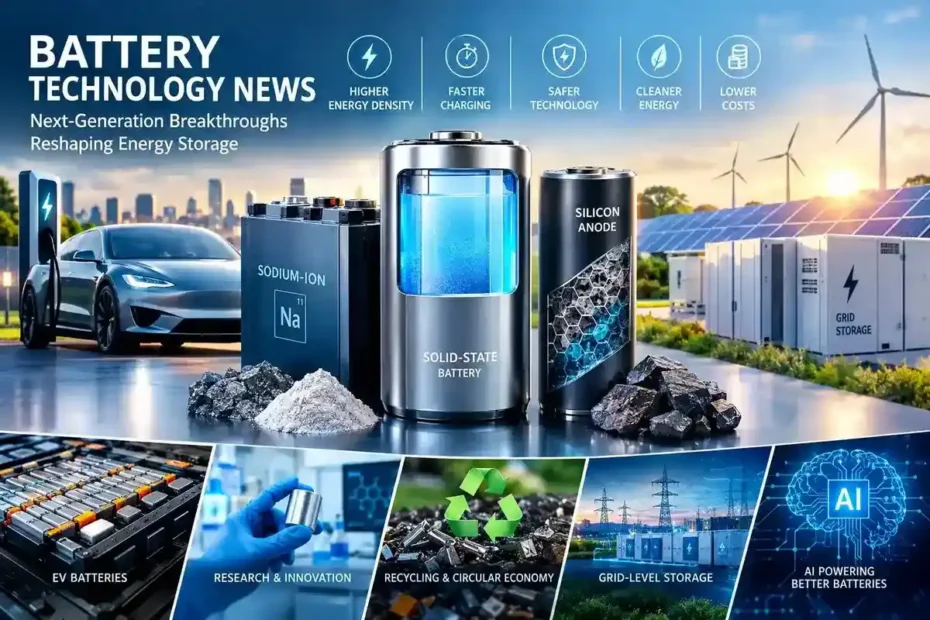
Battery Technology News:
Your phone dies by noon. Your EV loses 30% range in cold weather. The power grid cannot store enough solar energy for nighttime use. Old lithium-ion cells simply cannot keep pace with modern energy demands. Fresh battery technology news points to solid-state designs, sodium-ion chemistry, and silicon anodes that charge faster, last longer, and cost less.
What Is Driving the Surge in Battery Technology News This Year?
Global demand for energy storage has hit a breaking point. Electric vehicle sales crossed 14 million units in 2023, and grid operators now need massive battery installations to balance wind and solar output, according to the International Energy Agency.
Every week, new battery technology news surfaces from labs across South Korea, China, Germany, and the United States. Researchers are racing to solve three core problems: energy density, charging speed, and raw material cost.
The latest technology news cycle reflects this urgency. Governments have poured billions into domestic manufacturing, and private companies are scaling production faster than analysts predicted five years ago.
- EV battery demand will triple by 2030.
- Grid storage installations grew 130% year-over-year in 2024.
- Consumer electronics makers want thinner, safer cells for foldable devices.
These market pressures guarantee that technology news today will keep energy storage at the center of discussion.
Solid-State Batteries: The Holy Grail of Energy Storage
Solid-state batteries replace the liquid electrolyte inside a conventional lithium-ion cell with a solid ceramic or polymer layer. This single change eliminates the flammability risk that causes phone and vehicle fires.
Toyota grabbed headlines across japan technology news today outlets by confirming plans to mass-produce solid-state cells by 2027. The automaker claims its prototype achieves 745 miles of range on a single charge and recharges in under 10 minutes.
QuantumScape shipped its first commercial-grade samples to automotive partners in early 2025. The company’s solid-state cells survived over 1,000 charge cycles with less than 5% capacity loss.
Samsung SDI also opened a pilot production line in South Korea. Their solid-state pouch cells target premium EVs and electric aircraft.
The battery technology news surrounding solid-state designs is promising, but cost remains the primary hurdle. Current manufacturing runs roughly two to three times more expensive than standard lithium-ion production.
Sodium-Ion Batteries Offer a Cheaper Path Forward
Lithium prices spiked dramatically between 2020 and 2022 before dropping back down. This price volatility has led engineers to investigate sodium, an element abundant in ocean water and rock salt.
CATL began shipping commercial sodium-ion cells to vehicle manufacturers in 2024. These cells cost roughly 30% less to produce than lithium counterparts and operate reliably in sub-zero temperatures.
Northvolt unveiled a sodium-ion prototype built specifically for grid storage. The cell uses no lithium, cobalt, or nickel, which eliminates the supply-chain bottlenecks tied to mining rare minerals.
Sodium-ion cells store less energy per kilogram than standard lithium packs. That limitation makes them ideal for stationary storage and affordable city cars rather than long-range luxury vehicles.
Following latest technology news this week shows that sodium-ion chemistry is moving rapidly from laboratory trials to commercial assembly lines.
Silicon Anode Designs Push Energy Density Higher
Traditional lithium-ion anodes rely on graphite. Silicon can hold roughly 10 times more lithium ions than graphite, allowing manufacturers to pack significantly more energy into the exact same footprint.
Sila Nanotechnologies opened a dedicated factory in Washington state to produce silicon-dominant anode powder. Mercedes-Benz plans to integrate Sila’s material into its upcoming electric G-Class models.
Group14 Technologies supplies silicon-carbon composite materials to several battery manufacturers. Their material boosts energy density by up to 50% without requiring changes to existing factory machinery.
Industry-wide battery technology news confirms that silicon anodes solve energy density limits. Specialized carbon scaffolds now prevent silicon from swelling and cracking during fast charge cycles.
How EV Manufacturers Are Adopting Next-Gen Cells
Automakers are no longer waiting for theoretical designs. They are signing supply contracts, building joint ventures, and retooling factories right now.
Tesla continues to scale its 4680 cylindrical cell using a dry-electrode coating process to lower production costs. BYD’s Blade Battery, built on lithium iron phosphate chemistry, has become the standard for budget EVs worldwide.
Hyundai and LG Energy Solution opened a joint facility in Georgia capable of producing cells for over 300,000 electric vehicles annually. The facility has structural flexibility to shift toward solid-state chemistry later this decade.
The battery technology news coming out of the automotive sector shows a clear trend: manufacturers invest across multiple chemistries simultaneously to serve different price points.
Grid-Scale Storage Gets a Major Upgrade
Renewable energy cannot function without long-duration storage. Solar panels generate excess electricity at midday, but cities consume peak power during late evening hours.
Form Energy is building a manufacturing hub in West Virginia to produce multi-day iron-air batteries. These systems use basic rust chemistry to discharge power continuously for up to 100 hours.
Flow battery producers store energy inside large tanks of liquid electrolyte. Expanding storage capacity only requires installing larger fluid tanks, giving utilities an economical alternative to lithium packs.
Recent battery technology news in the utility sector highlights how long-duration storage keeps power grids stable while reducing total electricity generation costs.
Battery Recycling and the Circular Economy Push
Mining virgin lithium, cobalt, and nickel creates severe environmental disruption. Closed-loop recycling recovers critical minerals directly from retired battery packs.
Redwood Materials processes end-of-life battery packs and remanufacturing scrap to supply raw cathode materials back to domestic battery plants. The process recovers over 95% of battery-grade metals.
Li-Cycle operates regional processing centers across North America. Their hydrometallurgical method breaks down spent packs without high-heat smelting, cutting carbon emissions during recycling.
The European Union Battery Regulation requires all newly sold batteries to contain certified levels of recycled content by 2031. This standard is pushing global manufacturers to build transparent material recovery chains.
Safety Improvements That Reduce Fire Risk
Thermal runaway is the most critical safety issue facing battery manufacturers. If a single defective cell overheats, it can trigger nearby cells and cause an uncontrollable fire.
Engineers address this challenge with non-flammable liquid electrolytes and ceramic separators. In safety developments, battery technology news highlights how solid polymer electrolytes resist ignition even when punctured or exposed to extreme heat.
Modern battery packs incorporate active cooling channels and cellular firewalls. These barriers isolate failing cells and vent heat safely before runaway occurs.
Improved cell safety directly reduces warranty claims and lowers insurance premiums for commercial fleet operators and private vehicle owners alike.
Government Funding and Policy Shifts Accelerating Innovation
The U.S. Department of Energy committed billions to domestic battery processing, manufacturing, and recycling under federal infrastructure initiatives, as detailed on energy.gov. Programs managed by ARPA-E fund research aimed at pushing cell costs below $60 per kilowatt-hour.
The European Battery Alliance coordinates public and private capital across member states to reduce reliance on imported components. Over 30 gigafactories are currently planned or under construction across Europe.
Asian manufacturing centers still produce the majority of global battery cells. However, updated trade rules and clean vehicle subsidies in North America and Europe encourage localized production.
Federal backing guarantees that battery technology news will remain active as new grant winners commercialize high-performance storage concepts.
What Battery Technology News Means for Consumers in 2026
Lab breakthroughs generally appear in consumer products within two to four years. The technologies moving through pilot facilities today will directly influence what you buy in 2026.
Electric cars will offer 300 miles of driving range at price points below $25,000. Public chargers will supply 200 miles of range in roughly 10 minutes. Laptops and mobile devices will run for multiple days on a single charge.
The latest technology news today 2026 outlook indicates that solid-state packs will reach luxury vehicles first, followed by wider deployment in mid-tier commuter cars. Sodium-ion packs will power entry-level vehicles and home energy storage walls.
Understanding battery technology news today allows consumers to select vehicles and appliances with chemistries best matched to their regional climate and usage patterns.
Comparing Battery Chemistries: A Detailed Breakdown
Different energy storage chemistries serve distinct commercial purposes. The table below analyzes the five major battery types featured across top technology news past 24 hours industry reports.
| Battery Type | Energy Density | Charge Time (10–80%) | Cycle Life | Estimated Cost | Safety Rating | Current Status |
| Lithium-Ion (NMC) | 250–300 Wh/kg | 30–45 min | 1,000–2,000 | ~$130/kWh | Moderate | Mass Production |
| Lithium Iron Phosphate (LFP) | 160–200 Wh/kg | 25–35 min | 3,000–6,000 | ~$100/kWh | High | Mass Production |
| Solid-State | 400–500 Wh/kg | 10–15 min | 5,000+ | ~$200+/kWh | Very High | Pilot Production |
| Sodium-Ion | 140–160 Wh/kg | 20–30 min | 3,000–5,000 | ~$80/kWh | High | Early Commercial |
| Silicon Anode (Hybrid) | 350–400 Wh/kg | 15–20 min | 1,500–2,500 | ~$150/kWh | Moderate | Early Commercial |
Key takeaways from the comparison:
- LFP packs deliver long cycle life and dependable thermal stability for mass-market EVs.
- Solid-state architectures provide maximum energy density but carry high initial manufacturing costs.
- Sodium-ion cells provide the lowest production cost and strongest cold-weather resilience.
- Silicon anode designs enhance standard lithium chemistries without requiring new factory equipment.
The Role of AI in Battery Research and Development
Material discovery used to require years of repetitive physical testing. AI algorithms now evaluate millions of chemical formulations in days to find stable, conductive compounds.
Academic studies published in Nature Energy demonstrate how machine learning models accurately predict cell life cycles and degradation paths from initial test cycles. Google DeepMind and national research laboratories continue to identify novel solid electrolyte materials using predictive models.
AI also runs inside on-board battery management systems. Real-time algorithms adjust charging speeds based on ambient temperature and internal resistance to prevent cell damage.
Recent battery technology news highlights how artificial intelligence accelerates every stage of battery production, from early material screening to real-time pack safety monitoring.