Table of Contents
If you are searching because software GDTJ45 Builder does not work, you are probably trying to determine whether the problem is caused by your setup, a missing file, compatibility, or the software itself. The first thing to understand is that reliable technical information about GDTJ45 Builder is difficult to verify.
A search for the term brings up several websites describing GDTJ45 Builder as a software or development tool, but the descriptions are inconsistent. More importantly, there does not appear to be a clearly verified official product documentation source that explains its system requirements, supported operating systems, error codes, or installation process.
That means you should be careful before following detailed troubleshooting instructions written specifically for GDTJ45. Some online articles make very specific claims about its internal components and features without providing evidence to support them.
This guide takes a safer approach. It explains the common things to check when a software builder will not launch, build, save, or respond, while also showing how to determine whether you are dealing with a genuine software problem or an incorrectly identified tool.
Why Software GDTJ45 Builder Does Not Work
There are several possible explanations when software described as GDTJ45 Builder does not work.
The problem could be something simple, such as a damaged installation, incorrect file path, missing dependency, or insufficient permissions. It could also be caused by an incompatible version or a problem with the project itself.
However, there is another important possibility: GDTJ45 Builder may not be the actual name of the software you have installed.
Several current search results use the GDTJ45 name, but they do not provide consistent technical information. One independent analysis specifically notes that the term does not appear to correspond to a clearly verified commercial product, open-source project, or established development tool.
Before spending hours changing settings, verify exactly what application you are using.
Check the Software Name First
Look at:
- The application’s title bar
- The original installer filename
- The publisher or developer name
- The application’s About page
- The executable filename
- The website where you obtained the software
- Any error message shown when it starts
If the software has a different official name and “GDTJ45” only appeared in an article or search result, you may actually be troubleshooting a different application.
GDTJ45 Builder Not Working? Start With Basic Checks
If the application previously worked and has suddenly stopped working, start with the simplest possibilities.
Close the program completely and then open it again. If that doesn’t help, restart your computer.
This sounds obvious, but restarting can clear temporary processes and files that prevent an application from starting correctly.
You should also check whether the problem affects one project or every project.
For example:
- If one project fails but another opens, the project may be damaged or incorrectly configured.
- If every project fails, the installation or environment may be the problem.
- If the application itself does not open, focus on installation, permissions, dependencies, or compatibility.
This distinction can save considerable time.
Check Whether the Installation Is Complete
A partially installed application can appear to work normally until you attempt an operation that requires a missing component.
If you recently installed or updated the software, consider whether the installation completed successfully.
Look for:
- Installation warnings
- Missing files
- Failed updates
- Antivirus or security software blocking files
- An installer that was interrupted
- A version that does not match your project
Do not download random replacement files from unofficial websites just because an error mentions a missing DLL or component. The safer approach is to use the original vendor’s installer or documentation, if a verified vendor exists.
If you cannot identify a trustworthy source for the software, that is itself a reason to stop and verify the application before continuing.
Check File and Folder Paths
A builder can fail when it cannot locate the files it needs.
This can happen after you:
- Move a project to another folder
- Rename a directory
- Change a drive
- Restore files from a backup
- Move a project between computers
- Remove a dependency
- Change environment settings
Suppose a project originally existed at one location and later moved somewhere else. A configuration file may still point toward the old location. The application can then open successfully but fail when you try to build or export the project.
Look through the project’s settings for references to files, folders, SDKs, compilers, or other required components.
Avoid changing several settings at once. Make one change, test the application, and record the result.
Read the Error Message Instead of Guessing
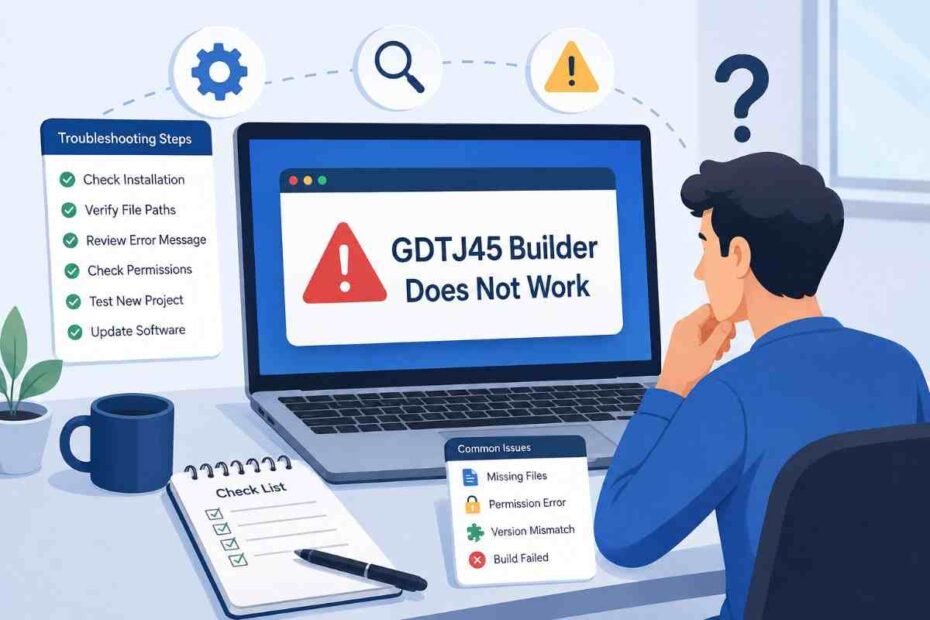
One of the most useful parts of GDTJ45 Builder troubleshooting is identifying exactly where the failure occurs.
An error such as “file not found” means something different from “access denied,” while a syntax error points toward the project rather than the installation.
Pay attention to words such as:
- File not found
- Permission denied
- Invalid path
- Module missing
- Version mismatch
- Unsupported format
- Build failed
- Connection failed
- Invalid configuration
If the program provides a build log, open it before trying complicated fixes.
A log may reveal the first point where the process stopped. The final error is not always the original cause, so read several lines around the failure rather than focusing only on the last message.
Check Compatibility
Compatibility problems are another common reason software stops working after an update.
For example, an application may have worked before an operating-system update, project migration, or software upgrade. A newer version may no longer work with an older component.
If you recently changed something, ask:
- What changed immediately before the problem appeared?
- Did the software update?
- Did the operating system update?
- Did you install a new extension or plugin?
- Did you move the project?
- Did you change the project’s dependencies?
This process is often more useful than randomly reinstalling everything.
Online discussions about GDTJ45 Builder also mention possible path, permission, and version-related causes, but these discussions should not be treated as authoritative documentation because the identity and specifications of the software itself are not clearly established.
Check Permissions
Sometimes an application can open but cannot create, modify, or save files.
This can happen when a project is stored in a location where the current user account does not have the necessary access.
Check whether you can manually create and edit files in the project’s folder.
If you are using a computer managed by a school, workplace, or another administrator, restrictions may also prevent applications from writing to certain directories.
Do not permanently disable security protections simply to make an unknown application work. If security software reports that a file is unsafe or suspicious, verify the software’s source before taking further action.
Test With a New Project
If the builder opens but refuses to build an existing project, create a small test project if the software provides that option.
This gives you a useful comparison.
If the new project works
The original project may contain:
- A damaged configuration
- A missing dependency
- An invalid file reference
- An incompatible project format
- A corrupted project file
If the new project also fails
The problem is more likely related to:
- The software installation
- Your environment
- Permissions
- Required components
- Compatibility
- A service or connection required by the application
This simple test can quickly narrow down the problem.
Clear Temporary Build Files Carefully
Some development tools generate temporary or output files while building a project. If those files become inconsistent, a rebuild may fail.
If the software’s official documentation specifically recommends cleaning its temporary or build output, follow that procedure.
Before deleting anything, make a backup of your project.
Do not delete source files simply because they are located near build files. The goal is to remove generated temporary data, not your actual work.
If you do not know which folders are safe to remove, leave them alone until you can confirm their purpose.
Reinstalling May Help, But Verify the Source
If the installation appears damaged, reinstalling can sometimes solve the problem.
However, reinstalling an unidentified application from a random download website is not a good troubleshooting strategy.
First verify:
- Who publishes the software
- Where the official installer is hosted
- Whether the application has documentation
- Whether the downloaded file matches the publisher
- Whether the version is appropriate for your system
This is especially important with GDTJ45 because publicly available information about the product is inconsistent. The official-looking pages currently indexed for the term describe it in different ways, while independent sources question whether it represents a verifiable software product at all.
What If the Software GDTJ45 Builder Error Appears After an Update?
If the problem started immediately after an update, do not assume that your project is broken.
Compare the old and new versions if that information is available.
Look for:
- Changed project formats
- Removed plugins
- Updated dependencies
- Different system requirements
- Configuration changes
- New security restrictions
If the software has an official support channel, provide them with the exact version number and complete error message.
Avoid installing an older version from an unofficial website simply to make the error disappear. Downgrading unknown software can introduce additional problems.
Common GDTJ45 Builder Problems and What They Usually Suggest
| Problem | What to investigate first |
|---|---|
| Program will not open | Installation, compatibility, permissions, security software |
| Program opens but freezes | Project size, temporary files, system resources, extensions |
| Build fails | Build log, missing dependencies, paths, project configuration |
| One project fails | Project-specific configuration or damaged files |
| Every project fails | Installation or environment |
| Files cannot be saved | Folder permissions and storage location |
| Error started after an update | Version compatibility and changed dependencies |
| Missing file error | File path and installation completeness |
| Unknown GDTJ45 download | Verify the software’s identity and publisher first |
The table is a beginning, not a diagnosis. The exact cause depends on the application and error message.
How to Fix GDTJ45 Builder: A Practical Troubleshooting Order
If you are unsure where to begin, work through the following order:
- Confirm the exact software name and publisher.
- Restart the application and computer.
- Record the exact error message.
- Check whether one project or every project is affected.
- Review the build or application log.
- Check file and folder paths.
- Check permissions and available storage.
- Review recent updates or configuration changes.
- Test a new, simple project if possible.
- Use the verified installer or official support documentation if reinstallation is necessary.
The important part is to test one possibility at a time. If you change five settings simultaneously, you may fix the problem without knowing what actually caused it.
Be Careful With Online GDTJ45 Advice
Search results for GDTJ45 contain articles that present very specific claims about its architecture, services, databases, collaboration systems, and technical requirements. Some even describe precise internal components. However, those claims are not consistently supported by verifiable official documentation.
For that reason, do not assume that every article using the phrase “GDTJ45 Builder” is describing a real, standardized software product.
One useful way to check an unfamiliar tool is to look for independent evidence such as:
- A recognizable software publisher
- Official documentation
- A legitimate download page
- A public issue tracker
- Established software directories
- Clear version information
- Consistent technical documentation
If none of these can be found, verify the software’s identity before attempting technical fixes.
When You Should Stop Troubleshooting
Sometimes continuing to experiment creates more problems than it solves.
Stop and investigate further if:
- You cannot identify the software publisher
- The installer came from an unknown source
- Security software flags the application
- Important project files may be at risk
- You are being told to download unknown system files
- Instructions require disabling security protections
- The error involves sensitive credentials or account information
Your project files should be backed up before making major changes.
If the software is associated with a legitimate organization, contacting that organization’s official support channel is preferable to relying on unrelated forum posts.
Frequently Asked Questions
Why is my GDTJ45 Builder not working?
There may be several possible causes, including an incomplete installation, incorrect file paths, permissions, project problems, compatibility issues, or simply an incorrect software name. Because GDTJ45 Builder does not have clearly established public technical documentation, verify the application’s identity before assuming a specific cause.
How do I fix GDTJ45 Builder?
Start by identifying the exact application and publisher. Then check the error message, project files, paths, permissions, and version information. Test whether a new project works before changing the existing project.
Is GDTJ45 Builder real software?
The available online information is inconsistent. Some websites describe GDTJ45 Builder as software, while independent analysis has found no clearly verified commercial product or established open-source project under that name. Therefore, it is better to verify the specific application you encountered rather than assuming the online descriptions are accurate.
Why does GDTJ45 Builder open but fail to build?
If you are using a genuine builder application that is being called GDTJ45, the problem could involve a project configuration, missing dependency, invalid path, permissions, or incompatible version. The build log is usually the best place to start.
Should I reinstall GDTJ45 Builder?
Only after confirming where the software came from and identifying a trustworthy installer. Reinstalling an unknown application from an unofficial source may create additional security or compatibility problems.
Conclusion
When software GDTJ45 Builder does not work, the best approach is not to immediately change advanced settings or download replacement files. Start by confirming exactly what software you have and who publishes it.
After that, work through the basics: check the error message, determine whether the issue affects one project or all projects, review paths and permissions, check recent updates, and test with a simple project if possible.
Most importantly, treat online descriptions of GDTJ45 Builder with caution. Current search results contain conflicting information, and there is no clearly established public technical reference that can be used to confidently verify all of the claims made about the software.
If you have a specific GDTJ45 Builder error, the exact message, screenshot, application filename, or installer name can provide much more useful information than the keyword alone. That evidence can help determine whether you are dealing with a genuine software problem, a project configuration issue, or an incorrectly identified application.
Pingback: Blooket Join: 5 Easy Steps to Join a Game